What a website costs in Qatar in 2026
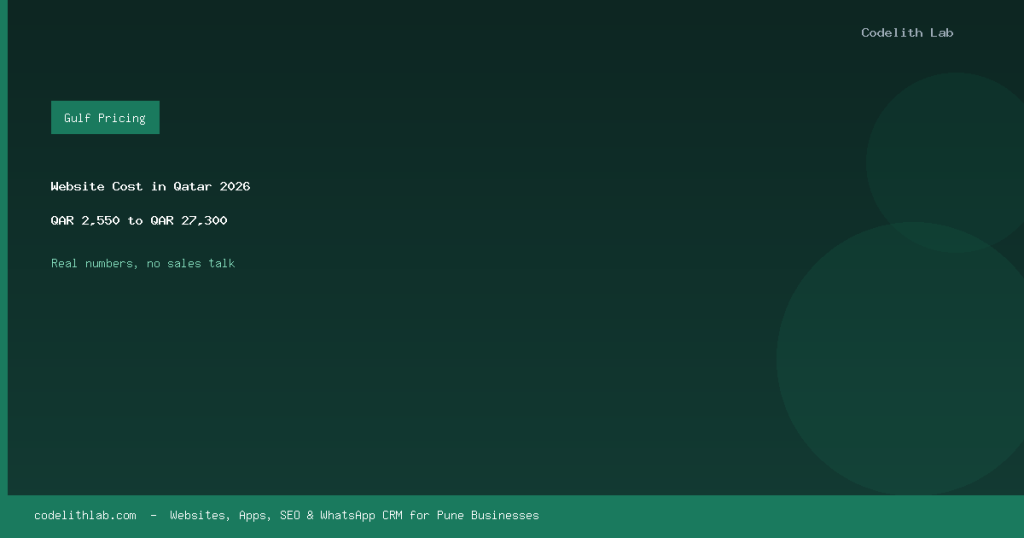
A business website in Qatar costs about QAR 5,800, roughly USD 1,600, from an offshore development partner, and three to five times that from a Doha agency for the same scope. Ecommerce starts near QAR 11,650. A web application or SaaS product starts near QAR 27,300.
Those are the prices we publish on our Gulf pricing page, not an opening bid that doubles after the discovery call. The riyal has been pegged to the US dollar at 3.64 for more than two decades, so the conversions below are stable, but bank charges and card conversion still move. Treat every riyal figure here as indicative rather than a quote.
Before we go further, the disclosure that matters. Our team is based in India. We work hours that overlap the Gulf business day, we bill in dollars, and we do not keep an office in Doha. That is exactly why the numbers look the way they do, and you should know it in paragraph three rather than after the contract is signed.
The price ladder, line by line
Here is the full ladder in riyals and dollars, with the build time a competent team should be able to hold to.
| Project type | Price (QAR) | Price (USD) | Typical build time |
|---|---|---|---|
| Landing page or one page site | 2,550 | 700 | 1 to 2 weeks |
| Business website, 8 to 15 pages | 5,800 | 1,600 | 3 to 5 weeks |
| Ecommerce store | 11,650 | 3,200 | 5 to 8 weeks |
| Web application or SaaS MVP | 27,300 | 7,500 | 10 to 16 weeks |
| Agency white label, per month | from 8,750 | from 2,400 | Ongoing |
| Care plan, per month | 440 | 120 | Ongoing |
Landing page or one page site
QAR 2,550 (USD 700). One page, one form, tracking, and speed. This is the right buy for a single campaign, a clinic opening in Al Sadd, a property launch, or any offer you want to test before committing to a full site. If somebody quotes QAR 12,000 for a one pager, they are selling you a website they have no intention of building.
The standard business website
QAR 5,800 (USD 1,600) covers eight to fifteen pages, a content management system your own staff can actually use, enquiry flows, WhatsApp click to chat, on page SEO, schema markup, and an interface designed for phones first. Mobile share of traffic in Qatar is high enough that a desktop first build is simply a broken build.
Ecommerce
QAR 11,650 (USD 3,200) buys a real store: catalogue, cart, checkout, one payment gateway integrated and tested against live cards, order emails, delivery zones for Doha and the rest of the country, and an admin panel your team can run without calling us. Add budget for multi location stock, a loyalty scheme, or a link into an existing ERP.
Web application or SaaS MVP
QAR 27,300 (USD 7,500) is the floor for software rather than a brochure: accounts, roles, dashboards, a database designed on purpose, and an API. Booking systems, field service tools, member and franchisee portals, internal operations software. If your idea has more than four core screens, budget above the floor and read our custom software page before you brief anyone.
Why a Doha agency quote runs several times higher
None of this is a comment on quality. A good agency in Doha carries costs an offshore team does not: commercial registration, an office in a market where rent is genuinely expensive, salaries priced to attract people willing to relocate to the Gulf, and a sales layer that has to be paid before a single line of code exists. Those costs are real, and they land on your invoice.
The second reason is quieter. A large share of local shops do not build in house at all. They win the account, add a margin, and subcontract the work to a team in South Asia or Eastern Europe. In that case you are already buying offshore development. You are just buying it through a broker who keeps half of what you pay.
Working with the build team directly removes that layer. What you give up is the ability to walk into an office in West Bay. What you should demand in exchange is everything that office was supposed to guarantee: a named project lead, fixed meeting times, written scope, and code sitting in a repository you own from day one.
What actually drives the price
Page count is the weakest predictor of cost there is. A fifty page site made of near identical service pages is cheaper to build than an eight page site with a live inventory feed. Two things move the number far more than page count does.
Integrations and moving data
Every system your site has to talk to adds days: a payment gateway, an accounting package, a CRM, a booking calendar, a WhatsApp Business API sender, an ERP. Each one needs credentials, a sandbox, error handling for the day the other side is down, and testing against real data rather than a demo record. Two integrations is a normal website project. Six is a software project and should be priced as one.
Content, translation and photography
Most projects that run late are not late because of code. They are late because nobody wrote the Arabic copy, the product photos are phone snaps from 2021, and the manager who has to approve the About page is travelling. Decide before signing whether copywriting, translation and photography sit with the vendor or with you. If they sit with you, staff it properly, because the build will finish and then sit there waiting.
Arabic and right to left: what bilingual really costs
In Qatar, bilingual is not a nice to have. Government tenders, established family businesses, and anyone selling to Qatari nationals rather than only to the expatriate market will need Arabic that reads like it was written in Arabic, not pushed through a translation plugin overnight.
What it costs to build
Expect a properly bilingual site to add roughly 30 to 40 percent to the build. That pays for a genuine right to left layout rather than a mirrored English one: navigation, forms, tables, directional icons, number and date formatting, and a typeface that renders Arabic cleanly at small sizes instead of falling back to something that looks like a rendering error. It also pays for Arabic URLs, headings and metadata so those pages can rank on their own merit.
What it costs to keep
This is the line almost everyone forgets. After launch, every change is now two changes. A new service page is two pages, a promotion is two banners, a blog post is two posts, and a catalogue update is two catalogues. Budget translation as a monthly running cost rather than a one off, or the Arabic half of your site will quietly go stale within a year and start telling visitors the wrong prices.
Hosting and data residency
Ask the residency question before the hosting question. If you handle personal data, health records or financial data, or you sell to a government entity, where the data physically sits can be a contract condition rather than a technical preference. Qatar now has in country cloud regions from more than one major provider, and local operators sell hosting too, so keeping data inside the country is genuinely practical in 2026 rather than an aspiration.
For an ordinary business website, the honest answer is that in country hosting is not required and often costs more for weaker tooling. A well configured Gulf region cloud with a CDN edge will feel faster to a visitor in Doha than a badly configured box down the road. If residency does apply to you, put it in the scope document in writing and let it drive the architecture. Discovering it at go live is an expensive way to learn.
Registering a .qa domain and what it needs
Qatar’s domain space is administered locally, and the names most businesses want, com.qa for a company or the plain qa extension, are not open registrations you complete with a card in two minutes. Expect an accredited registrar to ask for proof that a Qatari legal entity stands behind the request: commercial registration, trade licence details and authorised signatory information are the usual asks.
Two pieces of practical advice. First, never let the domain sit in your developer’s name. Register it under your company with your own email address as the administrative contact, whoever files the paperwork. Recovering a domain from a former vendor is one of the most miserable jobs in this industry. Second, document requirements and fees change, so confirm the current list with an accredited registrar or your PRO before you plan a launch date around it. Plenty of Qatari businesses run a dot com as the primary address and point the qa name at it, which is a perfectly sound strategy.
Payment gateways used in Qatar
If you are selling online, the gateway decision usually arrives late and delays the launch. Qatari merchants typically choose between a gateway acquired through their own bank, which tends to be cheapest per transaction and slowest to onboard, and a regional payment service provider operating across the Gulf, which onboards faster with a better dashboard at a slightly higher rate.
Three things to confirm before anyone builds against one. Does it accept the local debit scheme as well as international Visa and Mastercard, because a checkout that only takes international cards quietly loses a real share of Qatari shoppers. Does it support Apple Pay and Google Pay, which on mobile is now a conversion feature rather than a nicety. And what does onboarding actually require, since commercial registration, a corporate bank account and a compliance review are normal and can take weeks.
Rates, settlement periods and document lists differ by provider and change often, so get them in writing from the provider rather than from any blog, including this one. Start that conversation in the first week of the project, not the week before launch.
Want a real number for your project?
Send us your scope and we will come back with a fixed price, a milestone plan and a delivery date, in Gulf overlap hours. No discovery fee, no obligation.
What it costs after launch
A website is not a purchase, it is a small piece of infrastructure with a running cost. Work that cost out before you commit the build budget, because the most expensive site anyone buys is the one abandoned six months after launch.
| Ongoing item | What to budget | Notes |
|---|---|---|
| Care plan | QAR 440 (USD 120) per month | Updates, backups, monitoring, security patching, small edits |
| Cloud hosting | QAR 110 to 550 (USD 30 to 150) per month | Depends on region, traffic and whether residency is required |
| Domain renewal | Set by your registrar | Confirm current qa pricing with an accredited registrar |
| SSL certificate | Usually free | Pay only if your bank or a tender demands a specific certificate |
| Arabic content upkeep | Per word or a retainer | The line most budgets miss entirely |
| Payment gateway | Setup plus a per transaction rate | Confirm in writing with the bank or provider |
| New features | Quoted per change request | Agree the rate in the contract, not afterwards |
Our care plan is USD 120 a month, about QAR 440. Whether you buy it from us, from someone else, or run the list in house, somebody has to own it. An unmaintained site becomes a security problem inside a year.
When you should not buy a custom build
Some Qatari businesses should not be reading a price list at all. If you run a single cafe, a small salon, a two person consultancy, or you are still testing whether the offer works, a template platform is the correct answer, and anyone telling you otherwise is selling rather than advising.
Buy the template when your whole requirement is a presentable web presence, a menu or service list, a map, opening hours and a WhatsApp button, and you have nobody on staff to manage anything technical. You will pay a modest monthly fee and be live this month instead of next quarter.
Move to a custom build when the site has to do work: bookings that touch your real calendar, stock that must match a physical shop, a catalogue large enough that the template gets slow, serious bilingual content, or an integration the platform simply cannot make. That switch usually happens because the template started costing more in add on apps and staff workarounds than a build would have. Run that calculation honestly and the decision makes itself.
How to buy so you do not get burned
Price is the least interesting part of any proposal. These are the terms that decide whether the project works.
A written scope that states what is excluded as clearly as what is included. Milestones with payments attached, typically a start payment and payments against delivered stages, never everything up front. Code and repository ownership in your company name from day one, with access you can verify yourself this afternoon rather than take on trust. A named change request rate, so a late addition becomes a priced decision instead of an argument. A support window with a stated response time. And a handover pack containing hosting and domain credentials, a database export, deployment notes and a walkthrough recording.
Then ask the question that separates serious vendors from the rest: if you disappear tomorrow, what does my team need to keep this running? A good partner has that answer ready in writing. If the reply is vague, lock in is the business model, and you should keep looking. How we handle scope, milestones and handover is set out on our web development page.
Also read: our Gulf pricing and engagement page lists every package, what sits inside each one, and how we run projects with clients across Qatar, the UAE, Oman, Bahrain, Kuwait and Saudi Arabia.