D2C Brand Website Design
A brand site your customers can buy from directly — pin-code check, COD and prepaid options, GST invoices and WhatsApp cart recovery. Brochure sites start at ₹24,999 in 7–10 working days; a full store is ₹99,999.
Marketplace sales look like growth until you read the settlement statement. Commission, return shipping, ad spend on your own brand name, and at the end of it you still do not know who bought. The buyer belongs to the platform. A D2C site changes that only if it handles the messy parts — cash on delivery, returns, pin-code coverage, claim compliance — instead of pretending they do not exist.
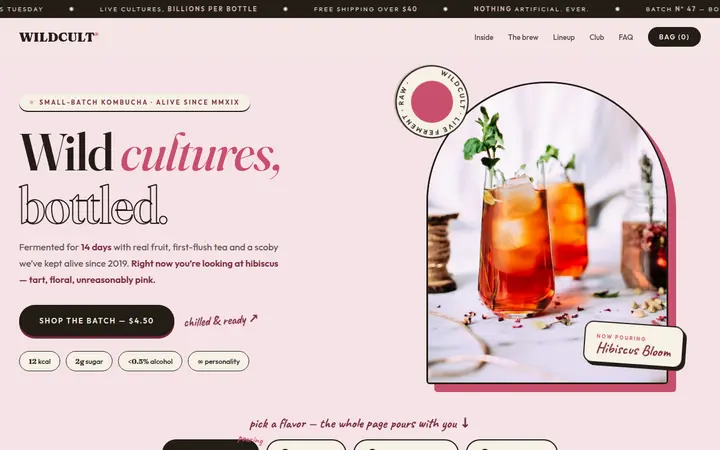
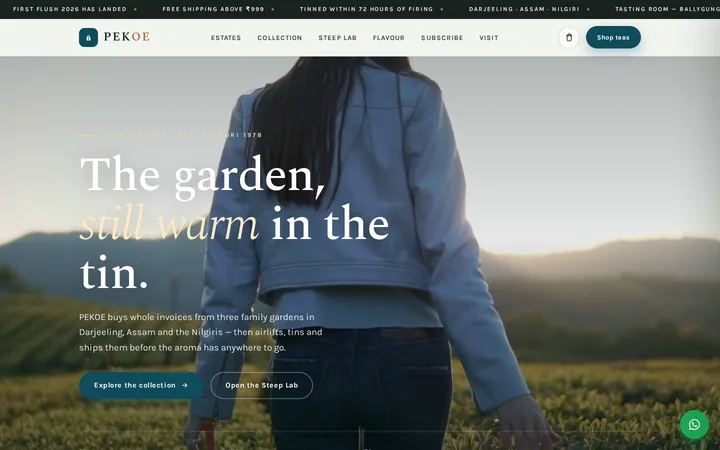
We start with the unit economics rather than the homepage: average order value, what share of orders will come cash on delivery, how many of those will come back undelivered, and what a repeat customer is worth. That decides whether you need Shopify, WooCommerce or something headless, and how much of the budget goes into checkout instead of animation. The three demos below — Glowé Botanicals, WILDCULT and PEKOE — are live and open on a phone, so you can test the flow yourself.
Renting customers from a marketplace, and what it costs to stop
Almost nobody types a category term and lands on a new D2C brand. Discovery happens in a feed — a Meta ad, a reel, a friend’s recommendation — and the first thing an interested buyer does is search the brand name. What they find at that moment decides the sale. If the top result is a marketplace listing, the order goes there, the platform takes its cut, and the customer’s phone number is never yours.
The buyer is also running three checks in about forty seconds: is this real, will it reach my pin code, and can I pay cash. Indian D2C still runs 40–60 per cent cash on delivery in most categories, and COD carries the return-to-origin problem that quietly eats margin — forward freight, reverse freight and a product that comes back opened. A site that hides delivery information until the last checkout step is choosing to learn about serviceability after the packaging has been printed.
Most brand sites we are asked to rebuild fail on detail, not on design. A skincare page with no full ingredient list. A food page with no FSSAI licence number, net quantity or shelf life, which the labelling rules expect and which a careful buyer looks for. A cosmetic carrying a claim that CDSCO rules do not permit on a product of that class. Reviews that are five-star text with no photograph, which nobody believes any more. And a checkout asking for eleven fields when phone number, address and pin code would have done.
From pin-code check to refill reminder
The build list for a D2C store looks nothing like a services site, and most of it sits after the “Add to cart” button. Glowé Botanicals shows the subscription side, WILDCULT the beverage catalogue and bundles, PEKOE the single-estate story pages.
- Product page with ingredient or INCI list, net quantity, shelf life, batch and licence details, and claims written to what FSSAI or CDSCO rules permit for that category
- Pin-code serviceability check on the product page with an honest delivery estimate, taken from your courier’s serviceable list rather than guessed
- COD switched on or off by pin code and by cart value, with a prepaid discount shown as a line item so the buyer sees what switching saves
- Shiprocket or Delhivery integration for label generation, a tracking page on your own domain, and NDR follow-up over WhatsApp
- Abandoned-cart recovery on WhatsApp instead of email, because open rates in India are not comparable
- Subscriptions and refill reminders timed to pack size, so a 30-day serum prompts on day 24 rather than never
- Bundles, sampler kits and a build-your-own-box page, which lift average order value more than any banner
- Reviews with customer photographs, moderation, and a request that fires a set number of days after delivery, not after dispatch
- GST invoices with HSN codes, emailed automatically and downloadable from the order page
- Razorpay, PhonePe and UPI, with UPI intent tested properly on Android where most of your traffic sits
- Meta pixel, Google tag and first-party events configured before launch, plus returns and shipping policies written in plain language rather than copied from another store
- Caching, image compression and a checkout load-tested for launch day, because one reel that performs sends more traffic in an hour than the whole previous month
The arithmetic that decides whether a store is worth building yet
Before quoting we ask for three numbers: orders a month, average order value, and the share of dispatches that come back undelivered. A brand doing under about thirty orders a month, all of them from one Instagram account, does not have a website problem. It has a demand problem, and a ₹99,999 store will sit there looking good. A ₹24,999 catalogue site with WhatsApp ordering is enough until the volume argues otherwise.
Once volume is there, the RTO number does the arguing. At a quarter of COD orders coming back you are paying freight both ways on those shipments plus the cost of restocking or writing off the goods. Two changes usually move that more than a redesign: a prepaid discount visible on the product page and not only at checkout, and an order-confirmation message on WhatsApp that lets the customer fix the address or cancel before the label prints. Both are cheap, both are dull, and both are why a store starts paying for itself.
On ranking, be realistic. The large marketplaces will out-rank a young brand on generic category searches for a long time, and that is not a fight worth funding in year one. What you can own is your brand name, your ingredient and comparison pages, and the long questions people actually type — that is where an SEO budget earns back. After launch someone on your side has to own the catalogue: new SKUs, stock status, price changes, review moderation. We build the store on the same web development service stack as our other work, open every account in your company’s name, and record a short screen video for whoever runs it day to day. If nobody on the team will do that, put it on the care plan at ₹1,499 per month rather than assume it maintains itself.
Our D2C Brand Website Design solutions
What it costs, in the open
Fixed scope, fixed price, fixed date. Written into the proposal before you pay anything.
| Package | What is included | Price | Timeline |
|---|---|---|---|
| Business Website | Up to 7 pages · mobile-first custom design · WhatsApp + click-to-call buttons · contact form · on-page SEO basics (titles, meta, schema) · Google Business Profile link · SSL, speed and security setup · 2 revision rounds · 30 days post-launch support | ₹24,999 | 7–10 working days |
| Business Pro + SEO | Up to 15 pages + blog · custom design system · on-page SEO for 10 keywords · Google Search Console, Analytics and Business Profile setup · Core Web Vitals optimisation · lead forms into WhatsApp (ZupiChat inbox, first month free) · 3 revision rounds · 60 days support | ₹49,999 | 2–3 weeks |
| E-commerce Store | WooCommerce, Shopify or custom · up to 100 products uploaded · Razorpay / PhonePe / UPI · Shiprocket or Delhivery shipping · GST-compliant invoices · coupons and offers · abandoned-cart WhatsApp recovery · 90 days support | ₹99,999 | 3–4 weeks |
| Subscription and refill reminder engine | Optional add-on for this industry, quoted on the same invoice | ₹9,999 | with the site |
Prices exclude 18% GST · payment is 50% to start and 50% at launch. Most D2C brands take the E-commerce Store at ₹99,999 because COD rules, Shiprocket dispatch, GST invoices and WhatsApp cart recovery are all inside that tier; the ₹24,999 site suits a brand still testing demand.
Open these on your phone right now
Part of our library of 195 live demo websites. Pick the one closest to your business and tell us “I want this”.

What you get
Orders you own
Lower RTO losses
More prepaid orders
Higher repeat purchase
Survives launch-day spikes
Why businesses choose Codelith Lab
Enterprise-Level Thinking
Solutions designed for long-term growth and scalability.
Dedicated Project Management
Clear communication and efficient execution throughout.
SEO-Ready Development
Every project follows modern SEO best practices.
Security-First Approach
Protecting businesses and customer data.
Innovation & Automation
Leveraging AI, automation and modern technologies.
Long-Term Partnership
Ongoing support, maintenance and growth assistance.
How we deliver
Discovery
Understanding your goals, challenges and opportunities.
Strategy
Planning the best solution for your business.
Design
Creating intuitive and engaging user experiences.
Development
Building secure, scalable, high-performance solutions.
Launch
Deploying and optimizing for success.
Support & Growth
Continuous improvement, support and growth.
Industries we serve
D2C Brand Website Design for businesses across India
Delivered remotely with WhatsApp updates and Google Meet reviews. Headquartered in Pune, working with clients in:
Frequently asked questions
Other services
Website Development
Professional business websites, ecommerce stores, corporate sites, landing pages, and custom web applications built to strengthen…
Learn moreMobile App Development
Custom Android, iOS, Flutter, and React Native applications built to improve customer engagement and streamline business…
Learn moreDigital Marketing
SEO, Google Ads, Meta Ads, social media marketing, and lead generation campaigns designed to grow your…
Learn moreSEO Services
Search engine optimization strategies designed to improve visibility, increase organic traffic, and generate qualified leads.
Learn moreZupiChat CRM & WhatsApp
Manage customer conversations, automate communication, improve support, and increase sales through our WhatsApp CRM platform —…
Learn moreSaaS Development
Build scalable SaaS products, white-label software, subscription platforms, and customer portals with future-ready architecture.
Learn moreAutomation & AI Solutions
Automate repetitive business tasks, improve productivity, and implement AI-powered business systems, agents and chatbots.
Learn moreDomain & Hosting Solutions
Secure domains, cloud hosting, VPS, dedicated servers, business email, and infrastructure management for modern businesses.
Learn moreWebsite Maintenance & Support
Keep your website secure, updated, optimized, and performing at its best with ongoing maintenance and technical…
Learn moreCustom Software Development
Custom CRM systems, ERP software, portals, business applications, and enterprise software tailored to your requirements.
Learn more